
by Bill Simons, Secretary, UUP Oneonta
Armand played a big role in my migration from union member to UUP activist. It was during the first year of the Cuomo administration — that of Mario not Andrew — and the year was 1983. Raising the specter of $1.8 billion NYS deficit — big money in those days — Governor Cuomo called for a reduction of 14,000 state jobs. At SUNY and other state institutions, there was fear. But UUP mobilized, and the Oneonta Chapter filled a bus. Tagging along with Armand, who was no stranger to NYS politics, I witnessed the power of collective action on the decisions of Albany legislators. Most of the dreaded layoffs never transpired. Although it took another decade and the prodding of Ed Wesnofske and Loraine Tyler for me to run for UUP office, it was Armand who started me on that path.
Although he never sought union office himself, Armand was a UUP stalwart. He held many leadership roles in the Oneonta community, SUNY Oneonta, and professional associations, but within the union he exemplified the best of the UUP grassroots base. From UUP’s 1973 inception onward through the next half century, he was a strong supporter of the union, even in retirement.
He was a fixture — and often a vocal one — at many Chapter meetings. Armand continued to advocate for SUNY and wrote for The Sentinel. During the 16 years I served as UUP Oneonta president, Armand shared important insights about SUNY, and, along with Ed, my wife Nancy, and Academic VP Rob Compton, was one of the few people to tell me loudly when I was wrong.
Through abundant contributions to SUNY Oneonta, Armand demonstrated the centrality and commitment of UUPers to the institution. He was a master teacher devoted to his students. In addition to memorable American history surveys, Armand taught highly regarded courses concerning the Colonial era, American Revolution, and Native Americans. His dramatic presentations could transport mesmerized undergraduates back to the 1692 Salem witchcraft hysteria or the drafting of the Declaration of Independence. As the years rolled by, appreciative former students remained in contact, evolving into friends.
A prolific scholar, Armand’s articles appeared in prominent disciplinary journals, and he authored three seminal books. His Hugh Lenox Scott, 1853–1934 Reluctant Warrior is the definitive biography of an important American life.
Armand evolved into a jack of all trades. Supervising interns, he made trips to government, non-profit, and commercial sites in New York City, displaying a native’s virtuosity in navigating urban traffic. Armand brought order — for a time — to the college catalogue. With his beloved future wife Carolyn — herself an iconic figure in Human Ecology — he sought to rationalize assessment and prevent its metastasizing. Armand contributed considerably to the growth of the Graduate Program during its period of ascent.
Following a robust campaign, featuring him calling on and dialoguing with every registered voter in Ward 5, Armand won election to the Oneonta City Council. As a councilman, he represented his constituents conscientiously and effectively, blocking a misguided project that would have diminished the quality of residential life.
Images of Armand across the decades cascade across my consciousness. Among the many, a tableau from mid-afternoon on Friday, December 9, 1988, remains vivid. I just finished the last class of the semester in a course on social & intellectual history. After speaking post-class with a few students, I stepped out of Shumacher 200 into the lobby. To my surprise, there was Armand accompanied by Political Science prof and first president of UUP Oneonta Denny Shea. Standing together, they looked intently at me. Armand, a Republican, and Denny, a Democrat, were political rivals in local politics but both dear friends of mine. They handed me the semester’s final issue of The State Times, the SUNY Oneonta student newspaper, then published in print, and instructed me to read a letter to the editor bearing eight signatures. I did and felt increasingly uneasy as I read a vitriolic denunciation of my role in sponsoring a recent lecture by a Fathers’ Rights advocate. The letter by signatories who had neither attended the program nor demonstrated awareness that a publicly available videotape of the event existed, accused me of creating a violent atmosphere. In something akin to shock, I looked up from the printed page, and Armand and Denny, meeting my gaze, told me, “You are not alone.” And in the hard-fought but ultimately victorious battle ahead to preserve freedom of speech on campus, I was not. (William Simons, “Intimidation as Academic Debate,” Academic Questions, June 20, 1993, pp. 63-70.)
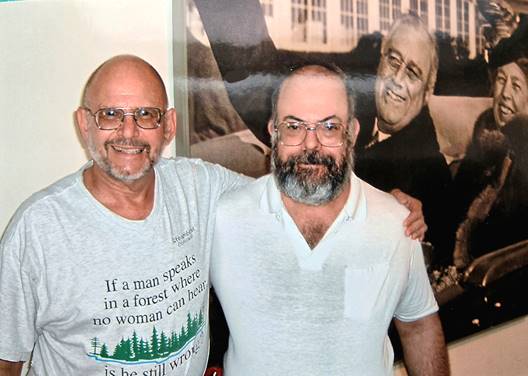
Armand bequeathed memories in multiple genres. At a Damaschke Field ballgame circa 2000, I periodically spouted baseball trivia as Armand and I cheered the Oneonta Tigers. However, every time I did so a solitary older man, draped in a well-worn trench coat and his head topped by porkpie hat, would without encouragement trump my stories. He sat in the same bench row immediately to our right. Toward the end of the game, I asserted that complete games had become rare in baseball and no American League pitcher had reached 20+ since the mid-1980s. The venerable irritant immediately added, “Yes, not since Bert Blyleven completed 24 games in 1985.” Armand opined, “The old guy knows more than you.” It turns out that the know-it-all was Jim Hamilton, standout baseball columnist for The Daily Star.
Often accompanied by our mutual friend Gerrit Gantvoort, Amand and I walked thousands of miles over the years. Our summer route notched laps through Neahwa Park. Typically, we ended the excursion at the Golden Guernsey where the ice cream bill rotated. In those days, a wooden outfield fence precluded us from checking the ballgame score as we passed Damaschke Field. Thus, in the preseason Armand brought a mallet and chisel so we could knock through a knothole to create a peephole in that outfield fence. As Armand readied the spot, Gerrit scouted the road to the left for obtrusive witnesses while I shouted reconnaissance reports from the right. Alas, the meticulously planned operation was scrapped when a passing police car took interest in our tools.
From his hospice bed in Tucson, Armand telephoned me and began by saying, “Sit down — I’m dying. I am not afraid, and I am not in pain.” The next day, Armand died — Thursday, December 18, 2025, of kidney failure. Amongst many other things, Armand La Potin was a UUP stalwart.
Download a print copy of the article here: