

COVID-19 INFORMATION
Date posted: March 16, 2020
Dear Member:
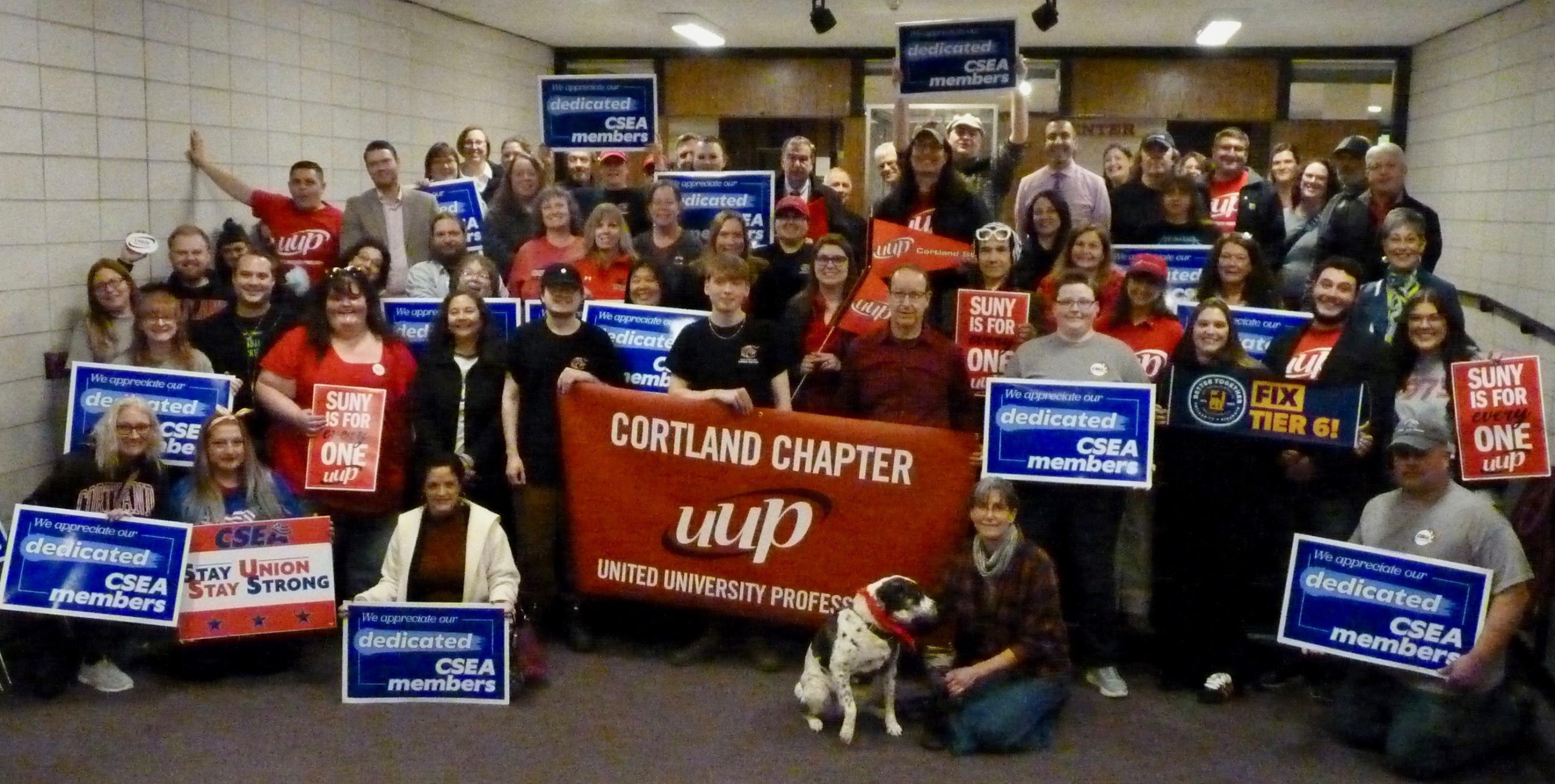
Please know that UUP is working closely with management at both the chapter and statewide levels to insure the health and safety of our members.
For the most up to date COVID-19 information please visit the SUNY Cortland College website, including the Frequently Asked Questions about COVID-19 and the UUP website.
Thanks!
Jaclyn Pittsley
Lecturer III
English
UUP Cortland Chapter President

Category: Uncategorized /
Course Teacher Evaluation: Biases and Best Practices
Date posted: March 12, 2020
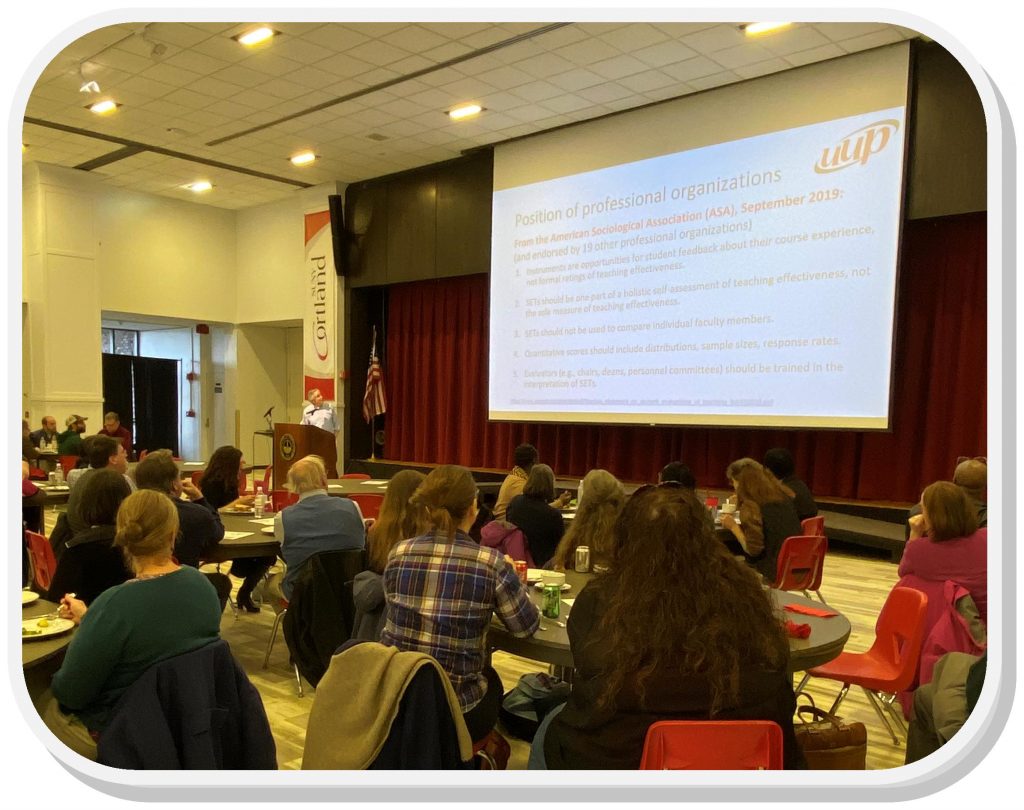
UUP Working Group on CTEs Presented by Professor Tom Pasquarello Political Science Department
Click here for slides from the presentation presented on 3/11/2020
Category: Uncategorized /
FUND SUNY NOW! RALLY
Date posted: March 4, 2020
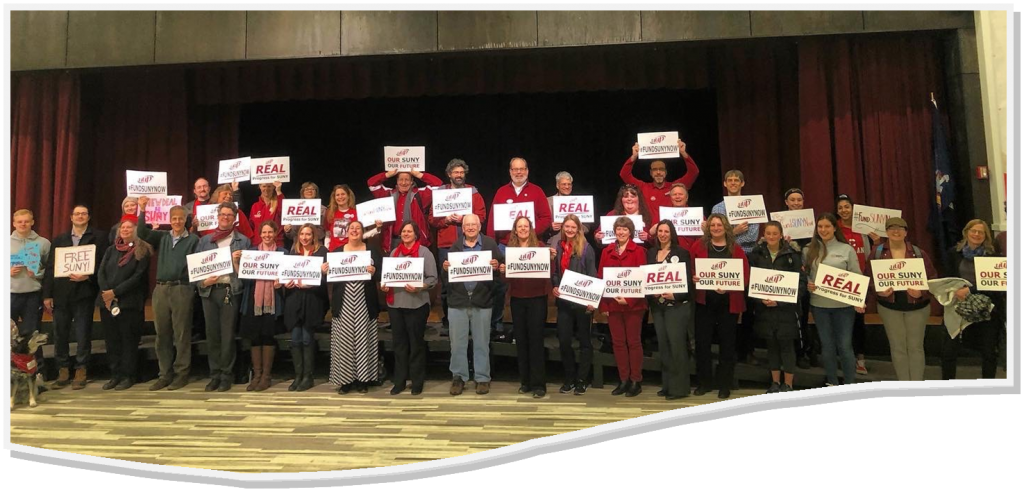
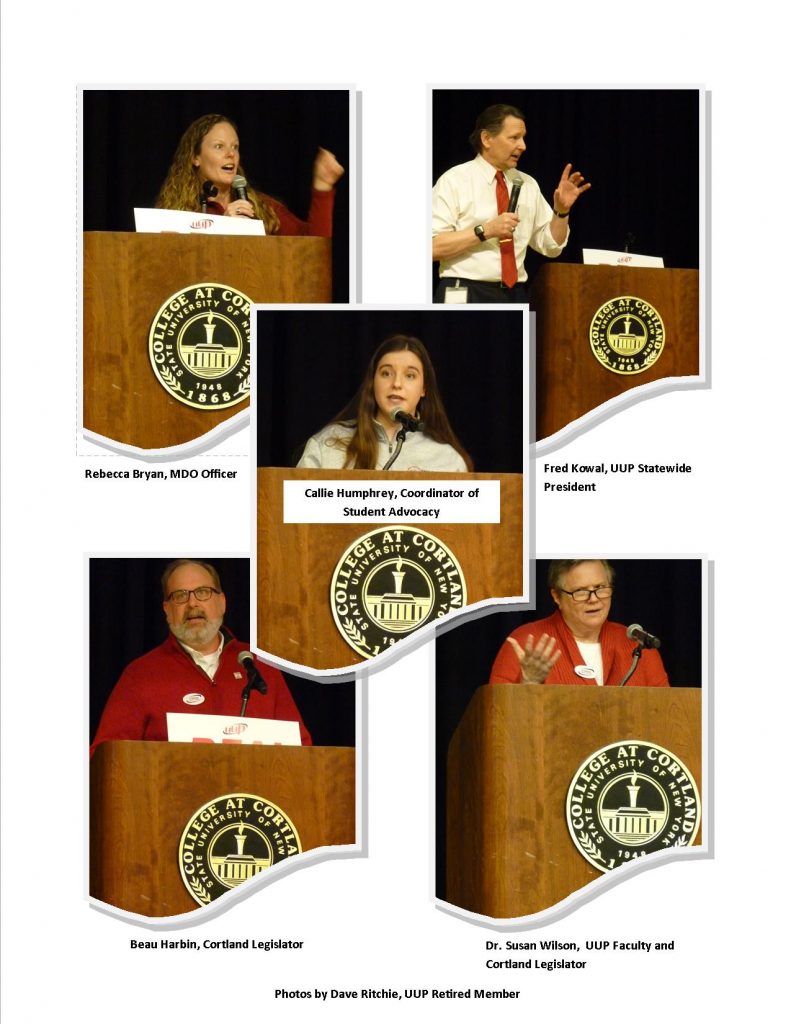
Fred Kowal, UUP Statewide President above, led the crowd in a chant of “Fund SUNY now!” that echoed through the Function Room in SUNY Cortland’s Corey Union. He told advocates that the only way to get more state funding for SUNY is to tell their elected officials to make it a priority.
Above, a group of Cortland Chapter advocates hold signs to amplify the importance of UUP’s push for more state funding for SUNY.
He also pushed for millionaires and billionaires in New York to pay their fair share through an enhanced Millionaires’ Tax and a pied-a-terre tax.
“I mean, c’mon, if you’re a millionaire and there’s a little increase in your tax rate, it will probably leave you as a millionaire,” Kowal said.
“We certainly cannot continue to allow the Legislature to underfund SUNY,” said Callie Humphrey, coordinator of student advocacy for SUNY Cortland’s Student Government Association. “A public higher education isn’t a privilege, it’s a right.”
Speakers included UUP Cortland Chapter President Jaclyn Pittsley; statewide Executive Board member and Cortland Chapter member Rebecca Bryan; and Cortland County legislators Susan Wilson and Beau Harbin.
Video taken by the Cortland Voice of the Rally: https://cortlandvoice.com/2020/03/05/uup-cortland-members-rally-demand-more-state-aid-for-suny-video-included/
Category: Uncategorized /
History of Physical Education and Sport Class Learns Jousting Skills
Date posted: March 3, 2020
by Nancy Kane, PhD, Kinesiology Department –
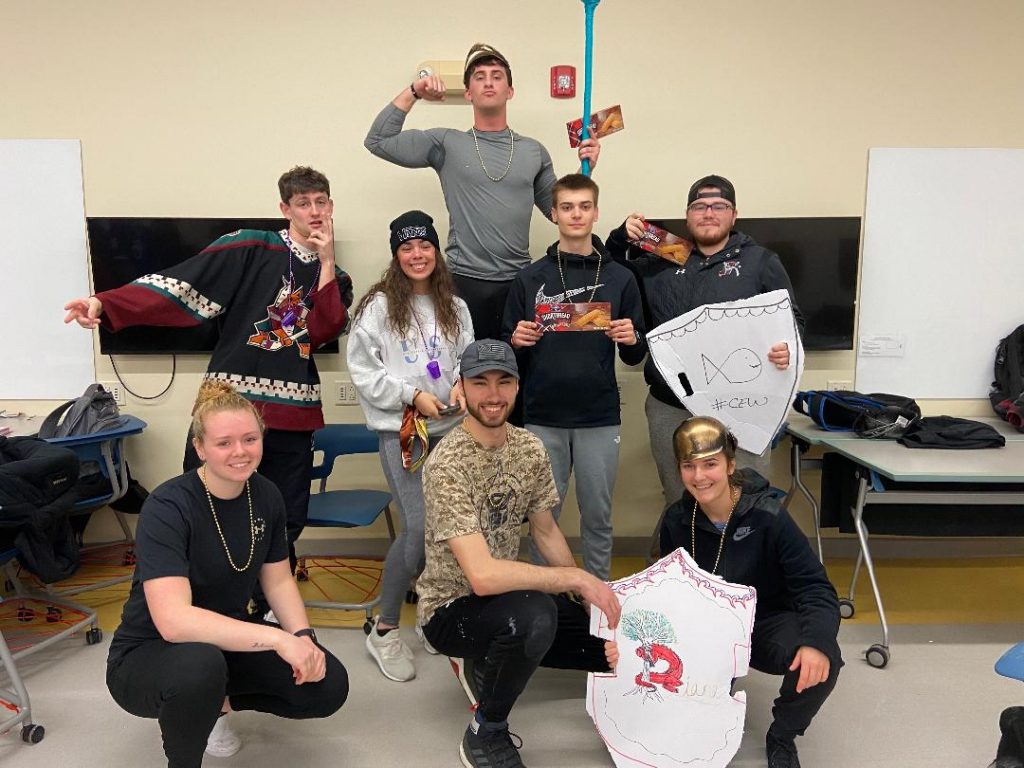
Cries of “Huzzah!” ring out from students on the sidelines watching classmates practice skills used in medieval European jousting. Some students are acting as knights, some as squires or heralds, some as royalty. Four of them are getting a good workout as horses carrying the knights. One serves as scorekeeper. Shields have been emblazoned by competing teams, and the knights wear helmets designating them as belonging to the Gold or Silver team. It’s the day of the EXS 197 Joust, in which students in the History and Philosophy of Physical Education and Sport class experience some of the training used by knights in training.
The event was created by Dr. Nancy Kane (’13), who wanted to bring history to life after researching the training methods used in medieval times for her new textbook, History and Philosophy of Physical Education and Sport (Cognella, 2020). The book includes research and kinesthetic activities for each chapter to give students an engaging way to connect with the past and deepen their understanding. Kane was assisted in her research by Jeremy Pekarek, Archivist and Instructional Services Librarian at the Memorial Library Delta Collection, who made SUNY Cortland’s 1898 edition of Joseph Strutt’s book, The Sports and Pastimes of the People of England (1801) available for her study. “I could have read it online, but there is nothing like holding the book, feeling its textures, and studying the words and engravings up close,” says Kane, whose students previously met with Pekarek to learn about Cortland’s archives.
The skills for the students’ jousting day include tilting with jousting lances (made of pillow-topped salvaged bamboo sticks) to spear rings, hitting a target (or a squire), and eventually competing in single combat against another opponent on “horseback.” The various events are described in Strutt’s book as practicing against a quintain, which could mean any of a range of targets from posts to squires holding shields. Quintains could also be rings used as targets: Strutt notes that the French scholar, Charles du Fresne, sierur du Cange (1610-1688), indicated that the Florentines in Italy referred to tilting at rings as “correr alla quintana.” Strutt also credits ancient Roman military training as noted by Vegetius in his book, De re militari., in which knights and squires would use a tree trunk to practice ad palum (against the pole). Eventually, shields and other targets were added, and tilting for rings remained a popular pastime among youth for centuries after the last tournaments faded from memory.
Kane used Strutt’s first chapter in Book III with its illustrations to recreate the training techniques and adapt them for a modern classroom. Strutt’s quintain illustrations were taken from an early 14th century manuscript in the Royal Library, Les Etablissmentz des Chevalierie, which were studied by the engraver and historian Strutt. “Many of my students are physical education majors, and I want them to experience some ways in which we can make history live and they can integrate history into their future classes to bring extra variety and fun to their students. I love the interdisciplinary nature of the event,” Kane adds. Strutt wrote that there is a literary and performing arts component to the pastime of quintain, too. For example, Shakespeare refers to it in As You Like It (I, ii), when Orlando says, “My better parts are all thrown down/And that which here stands up/Is but a quintain, a mere lifeless block.” During the joust, Kane playsWe Will Rock You, a Queen song used in the 2001 Heath Ledger film, A Knight’s Tale, to inspire the competitors and to add excitement.
This is not the first time Kane has used her historical research in practice. While serving as Director of Dance for the Trumansburg Conservatory of Fine Arts, she successfully created and taught a class called Rough and Tumble to encourage young boys to become part of the program. It was based on German gymnastics, parkour or freerunning, and stage combat. With a background as an advanced actor/combatant in the Society of American Fight Directors, she has taught armed and unarmed stage combat to Cortland performing arts majors as well as members of the varsity football and gymnastics teams.
Jousts were the first instance in sports history in which scorecards were used, and the class scorekeeper eventually announces the champion of the day. With typical chivalry, Sir Ethan Irons (’21) invites the entire Gold team to pose for the photo with their shortbread cookie prizes (provided in lieu of a feast). Kane will later print and bring in copies of the photo for each member of the team as a memento. “Transformational Education is part of life at Cortland under our Campus Priorities,” Kane says, “and I love it when we can integrate different aspects of learning into memorable events!” Judging from the expressions on their faces in the photo, her students agree.
Category: Uncategorized /
DSI: Where’s the Merit?
Date posted: February 21, 2020
by Dan Harms, Chapter Vice President for Academics –
The Cortland refrain on our Discretionary Salary Increase money (DSI) process is that it rewards “merit.” Does it?
To start out, let’s say that the campus should be recognized for allowing employees to have a voice in the process of deciding how contractual DSI money is handed out, both in the application phase and giving them an appeals process. This is not something they’re required to do.
But is it about merit?
We’ve just received the data from the DSI allocation from the last round which ended in December. It begs for interpretation from someone who has actual knowledge of statistics, but what I can see troubles me.
Based on my interpretation of the data, the campus gave money to over three hundred DSI recipients – yet only about sixteen of those were part-time employees. Even with some caution as to these numbers, I can nonetheless ask the administration:
- Did less than twenty part-time employees on this campus merit a salary increase for their work?
Some might say, “We can’t give money to people who don’t apply.” First, be aware that the campus chooses not to report the number of applicants, just the number of awards, so it’s not clear whether part timers are applying or not. Second – if part-time employees aren’t applying, isn’t this an indication of a problem with the process? Third, we have used other processes in the past. Fourth – see below.
Remember, the total of all full-time and part-time salaries determines the amount of money the campus receives for DSI. We should avoid the process becoming one in which one group of faculty receives the overwhelming number of awards.
Second, we should talk about Information Resources, my own unit, which has many people doing hard, highly-skilled work crucial to the campus’ success. In addition, while the administration has made some effort to deal with salary compression in other units, IR has not been one of them. Thus, IR has many people eager for some reward for their efforts after many years, and many employees applied for DSI this round.
The first level of application review in IR went smoothly. When it reached the second level, however, management chose to avoid making any recommendations – something that the college has never done, to my knowledge. They left that call up to the third level – after the appeals process had ended. There, the decision was made to slash the ratings of many of the applicants, sometimes dropping them two tiers. Speaking for myself, my recommendation dropped from “Highly Recommended” to “Not Recommended,” and from talking with my colleagues, many others were equally dismayed with the results. The campus did grant another appeal period – for those who felt comfortable enough to write Erik – but the damage was done. Many people who had expected something for their efforts were deeply disappointed. Further, not a single part-time applicant from IR – and we did have them – received any DSI.
It’s true that the campus has only so much money to go around, but it does decide on how it allocates it in the process and the amounts of the awards at each tier. Thus, my second question:
2. How much should a “merit-based” rating of our performance depend on how many people in the unit also apply?
At this time, the next DSI process memos have already been mailed out. We’ll see how this round goes – but I’ve seen no indication anything will change in this next round.
Category: Uncategorized /
Our Bylaws, Our Union, Our Selves
Date posted: February 12, 2020


by Jaclyn Pittsley, President and Daniel Harms, VP for Academics –
SUNY Cortland Chapter of UUP’s bylaws are in need of amendment and revision! Our chapter bylaws govern our campus structure and they describe the functions of our local campus organization. The chapter bylaws have not been amended in many years and are seriously out of date.
The UUP bylaws committee, including Daniel Harms, Joe Westbrook, and myself, with a great deal of assistance from Jen Drake and David Ritchie, has been working for several years to amend the bylaws to reflect changes in the UUP Constitution and changes in the Chapter. I offer my thanks for their hard work.
These changes have to occur in order for our union to remain at the forefront of advocacy in these trying times of anti-union sentiment. Our bylaws as amended will now reflect important changes in categories of membership, counting of delegates, and continuing membership, in addition to changes to language and offices.
Please take a look at the highlights of these amendments listed below, and please make it a point to Attend Union Matters on April 1, 2020 in Corey Union Function Room and Vote on the bylaws. All members’ voices need to be heard, and all votes counted.
We need everyone’s help to keep our union functional and prominent in the fight to maintain and improve our terms and conditions of employment.
UUP Bylaws Highlights of Amendments – February 2020
Bylaws Notes
Bylaws brought in line with UUP Constitution and directives from statewide
Names of committees and officers changed
Increasing good governance
Article III, Membership, Section 2 – Categories of Membership
Confirms categories for Contingent Academic and Professional Members.
Section 3 – Classes of Membership
Adds Contingent and
Continuing Membership as categories
States the duration of Contingent Membership as being year-long
Establishes that dues payment is necessary for membership
States the rights of members for attending meetings and participating in
elections
Article IV, Section 3 – Meetings
Changes necessary quorum for a meeting to be 5% of the Chapter membership (just to make it easier to convene a meeting)
Article V, Section 1 – Chapter Officers
Vice President for Contingents becomes Officer for Contingents
Added Officer for Retirees, Membership Development Officer; removed Part-Time Concerns Representative as redundant
Section 2 – Selection and Term of Office
Establishes that Membership Development Officer and Grievance Officer are nominated by the incoming Chapter President for a two-year term
Establishes that the Executive Board may appoint an officer or hold a special election if no nominee is available or write-in votes don’t reach the threshold;
In case of a vacancy between the chapter elections and June 1, allows the incoming Chapter President to appoint an interim officer until the Executive Board meets.
Establishes presidential succession rules for officers
Section 3 – Duties
Allows the president to conduct Labor/Management meetings, sign checks if the treasurer is unavailable, supervise office staff, and appoint a Parliamentarian
Affirms that the Vice Presidents and Officer for Contingents are delegates
States that the treasurer should keep chapter monies in a bank account, and submit audit packets in a timely manner
Establishes duties for the Officer for Retirees, Membership Development Officer, and Outreach Chairperson
Article VI, Executive Board; Section 1 – Members
Changes the makeup of the executive board [?]
Section 2 – Duties
Confirms the Executive Board’s role in approving committee appointments and carrying out statewide policy
Lowers the number of appointed offices for which the Executive Board can define duties
Establishes that Executive Board members serve as delegates to the Delegate Assembly
Section 3 – Minutes
Stipulates that minutes shared with Chapter members should be approved beforehand
Article VII – Other Chapter Officers
Eliminates the alternate delegate, in favor of regular delegates
Establishes that the Executive Board may create only chapter officers who are non-voting, and may define the duties thereof
Article VII – Committees
Section 1 – Standing Committees
Clarifies which officers may attend Labor Management meetings, with the stipulation that others may be brought at the chapter president’s invitation
Provides membership for Part-Time Labor Management meetings, as well as the Contingent Employment Committee, the Affirmative Action Committee, Grievance Committee, Membership Committee, Outreach Committee, and Environmental Health and Safety Committee, if the chapter chooses to appoint them
Article IX – Chapter Elections
Section 1 – Chapter Election Dates
Chapter elections to be held in odd-numbered years, not “every two years”
Section 2 – Chapter Elections
Confirms that the Vice Presidents should be elected from their membership
Clarifies which positions are elected and which appointed
Grants the Executive Board the ability to appoint vacant positions for which no nominee or willing write-in candidate exists
Article X – Recall
Establishes a procedure to remove an officer for neglect, misuse of Chapter funds, or intentional misrepresentation, ending with a chapter vote for removal.
Article XI – Parliamentary Authority
Establishes that Robert’s Rules of Order applies to meetings in cases where the UUP Constitution or Chapter Bylaws are silent
Article XII – Governance
Section 1 – Construction and Severability
States that the UUP Constitution changes will automatically amend the Bylaws when these conflict
Provides that a copy of revised bylaws should be kept in the chapter office for examination
Section 2 – Amendment
Bylaws may be created by a petition sent to the executive board
A vote on an amendment may be held at a Chapter Meeting and take effect immediately
Category: Uncategorized /
A Noble Profession
Date posted: February 4, 2020
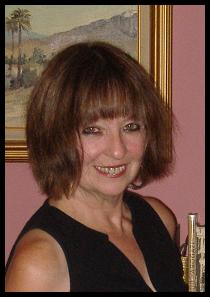
by Karla Alwes, Distinguished Teaching Professor, English Department –
Because there are so many protests to be made against the Trump administration, we may be forgiven not to have noticed a current trend in education funding that needs to be included in the growing slate of protests. Since the shockingly farcical idea to decimate funding for Special Olympics in 2018, proposed by either Education Secretary Betsy Devos or US President Donald Trump, neither of whom would own up to suggesting it, DeVos and Trump have gotten together to conspire against education altogether.
While teachers nationwide are striking for better working conditions, the cuts to federal education budgets continue to grow. According to the Center for American Progress, New York’s cut in funds for state grants in 2020 is $148,594,992. Nationally the budget cuts for state grants in education for all states have grown to $2,055,830,000. (In 2019, total cuts in education funding, the Center for American Progress advises, reached $8.5 billion [americanprogress.org/issues/education]).
Our students who aspire to teach, and who have always been told that to be a teacher is a noble and worthy profession, may be shocked to discover otherwise. Or, they may already understand the divide that exists, the one between the idea of public education for all, that the federal Secretary of the Education Department personally and publicly eschews for that other idea—private institutions of education that don’t need the government’s money because they have their own, a “sordid boon,” as the poet William Wordsworth may call it, because so much of it comes from the continuous tax cuts to the wealthy, paid for by the others.
For decades, public school teachers have had to pay for their own pencils, crayons, glue, gold stars, and whatever other paraphernalia help make up the classroom that invites children and students beyond childhood to experience the joys of learning. It seems that now those same teachers will have to pay for their own dignity as a public teacher, as we all struggle to restore what has become, through the back channels of Washington, the battered nobility and worth of our profession.
Category: Uncategorized /
Working with Dignity: A Special Imperative from Chapter President Jaclyn Pittsley
Date posted: December 6, 2019

In my role as Chapter President, during the last six months, I have served as a confidant to those who’ve been subject to treatment by others that requires me to remind folks of our commitment to excellence, solidarity, and mindfulness.
SUNY Cortland is one of the finest institutions in public higher education, and it pains me to hear that folks are requiring their colleagues to do things that are not a part of their professional obligation, such as being told to fetch mail, pour coffee, or run personal errands.
UUP is an inclusive environment where, as Dr. Seuss puts it, “Every Who down in Who-Ville, the tall and the small….” are represented and deserving of fair and equal treatment. We all deserve the right to work without fear of being asked to do things that are outside our professional obligations, especially by our fellow members and supervisors. No one wants his or her work degraded by unnecessary requests for “favors” of a servile nature, and no one wants his or her commitment questioned for pointing out these unfair and even outrageous requests.
All UUP members work with special protections and a special imperative: a voice with which they must expose injustice that occurs in their work environments. No one should be considered “too soft” to work at SUNY Cortland, especially when they’re brave enough to stand up for themselves and others. Such an accusation has no place in an institution such as ours: it smacks of hazing and makes the mind reel with its implications, especially considering our country’s profound support and progressive participation in recent #MeToo Movements. We all deserve the right to work without fear of punishment or reprisal for declaring, “NO, this is not what I have to do to get where I want to be.”
I say this not to chastise any fellow member who has made such a request of a fellow employee or of a supervisee. We have all, including me, asked at one time or another for a small favor of a colleague that is gladly done. However, we should be mindful of inclusivity and the dignity our colleagues deserve in performing their work for this institution. We have all made requests that may seem minor or trivial, and we may have made these requests many times without thinking of how the request makes the other person feel. I ask us now to think about it, to empathize with our fellow employees, to consider times we’ve imposed unfairly upon one another.
UUP is a muscle of change. We work for change in our terms and conditions of employment. We demand change in our environment. We progress beyond acceding to the ways that things have always been done. We are not a group to sit idly by while others endure ill treatment, lack of care, or retaliation for speaking out. We reach beyond the old and champion the new.
UUP members have specific obligations to themselves and our colleagues in the workplace. I hope, and I’m sure my fellow members would find it reasonable, that my colleagues will be able to view the experience of working with me in a positive way, filled with useful interactions, even on occasions when we may disagree. I want to continue to work toward this goal in the coming year, and I hope we can all do the same. Every human being on this campus – UUP Members or Non-Members, CSEA, PEF, CWA, student, administrator, guest, or visitor, Full-Time or Part-Time, Permanent or Temporary Appointee, new hire or long-serving senior member, supervisor or supervisee – deserves the respect of all colleagues and must be able to perform their obligation with dignity.
Category: Uncategorized /