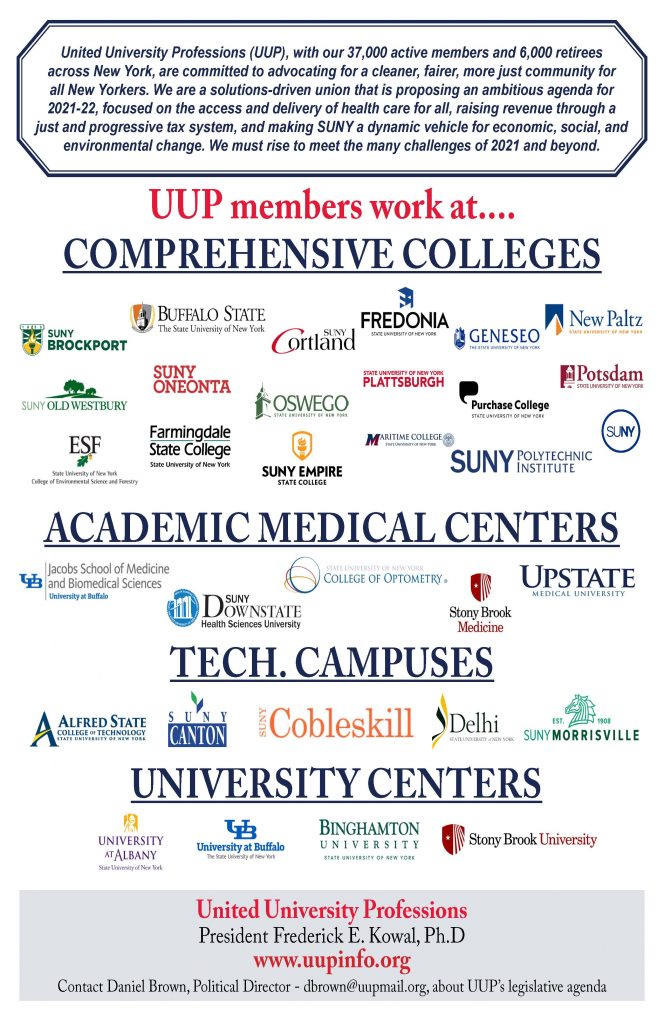
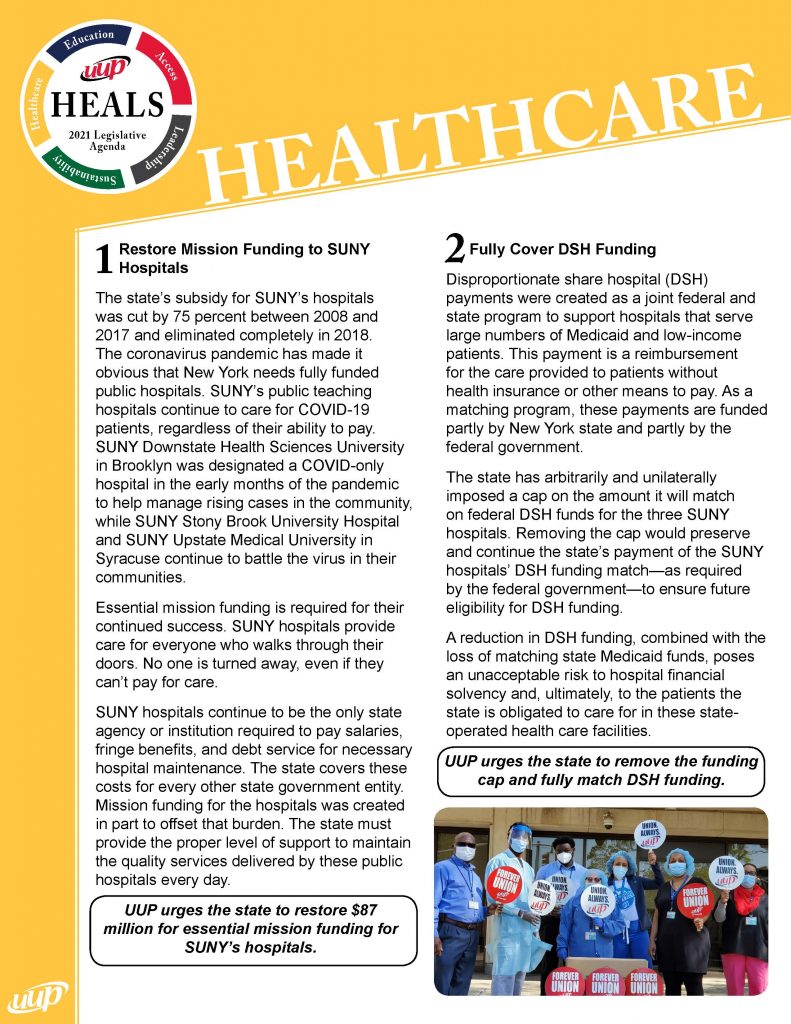
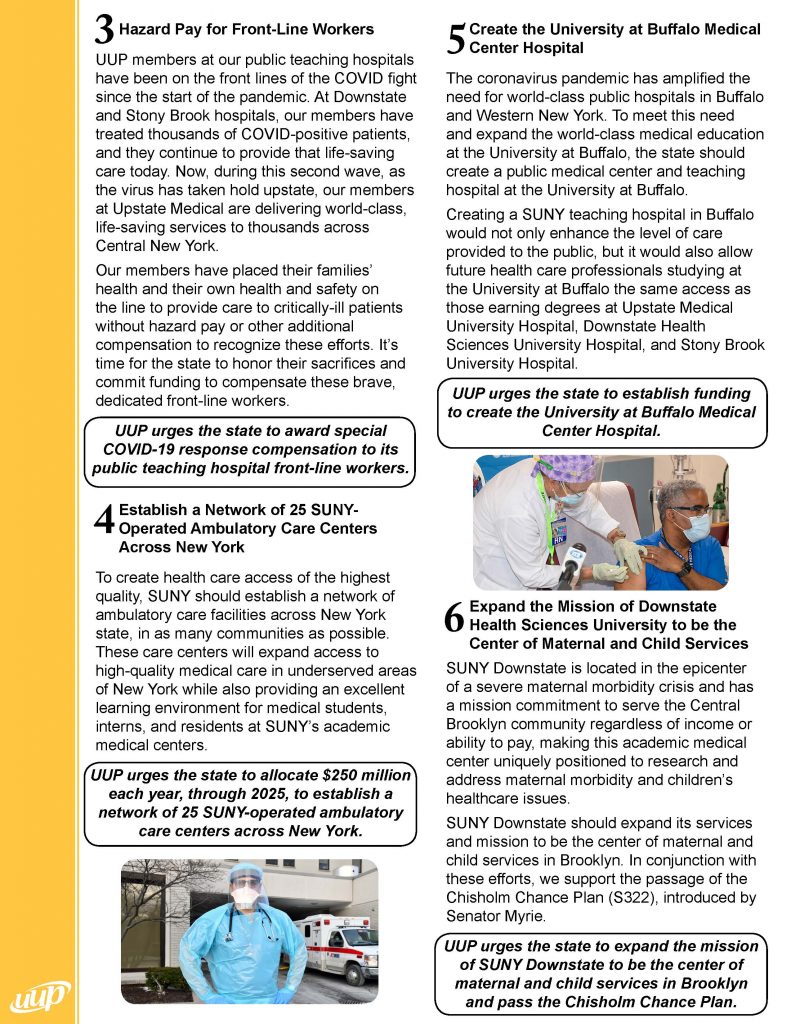
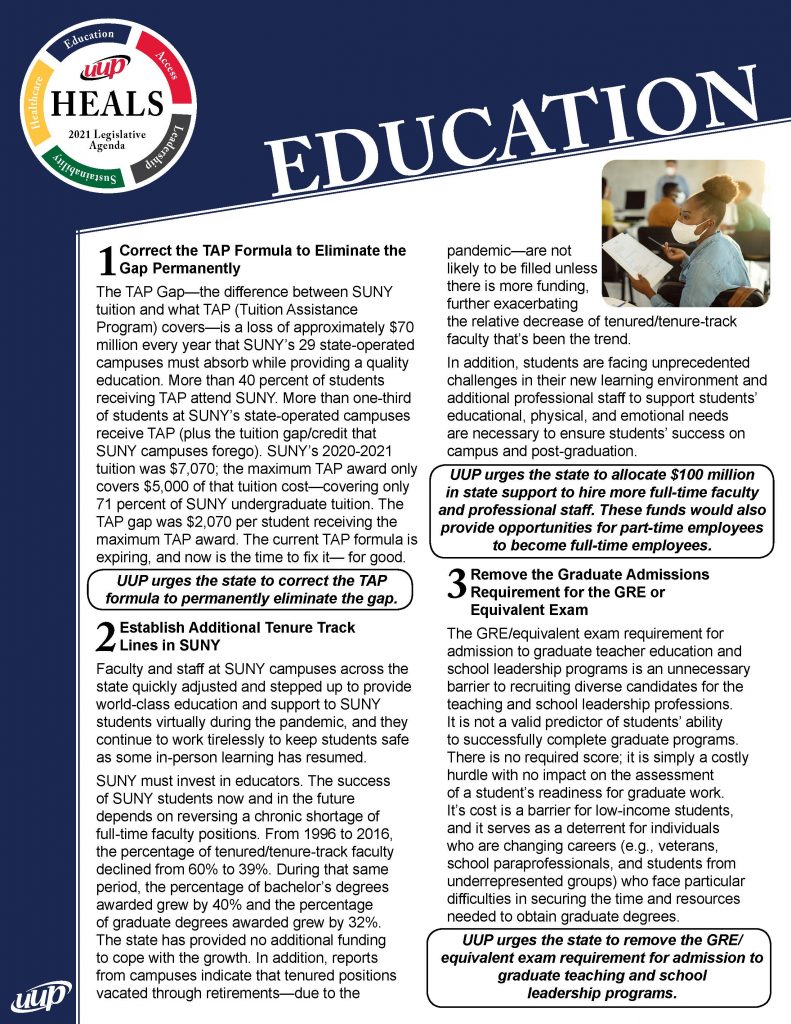
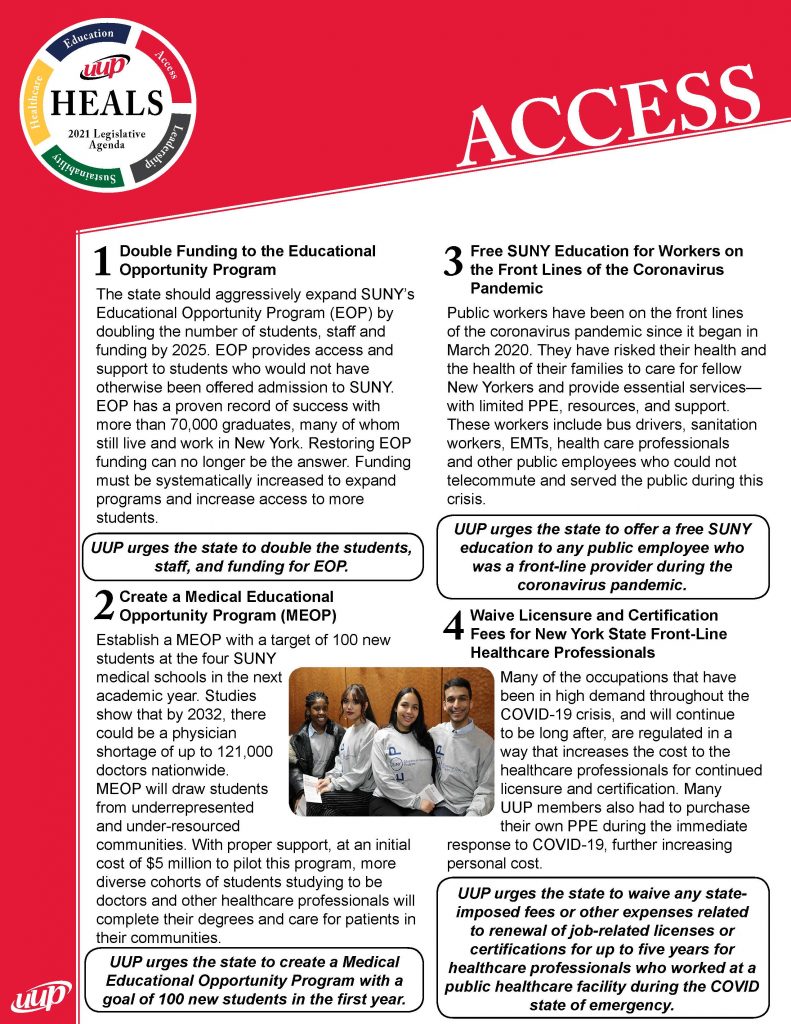
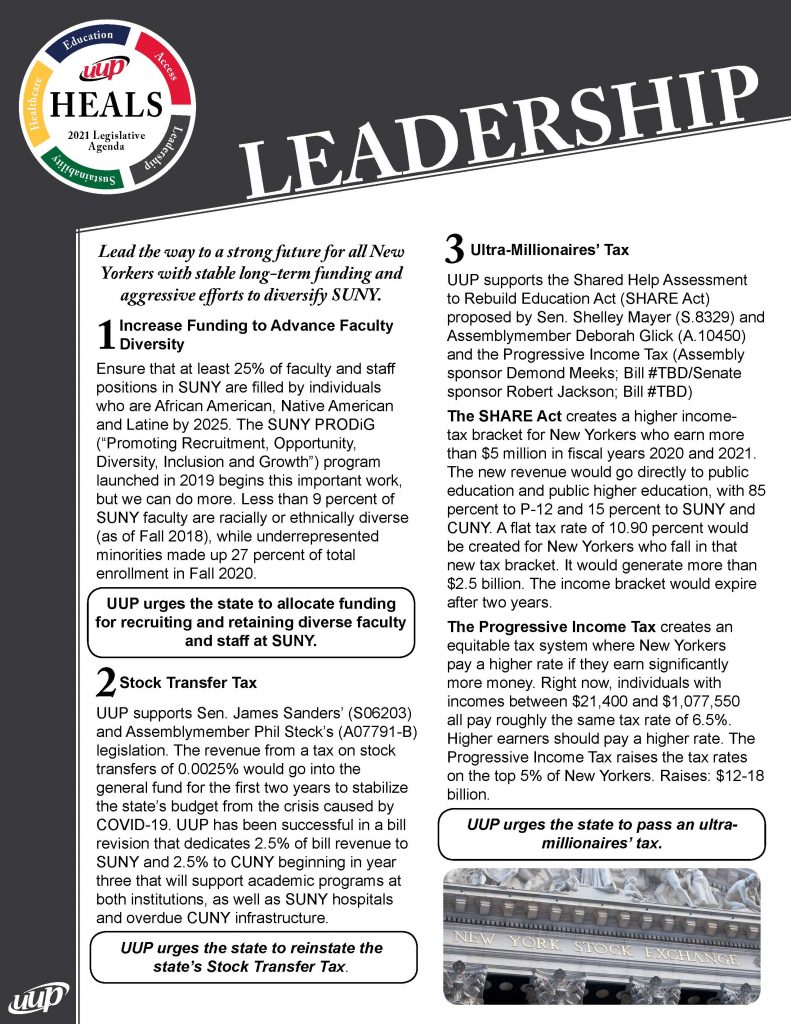
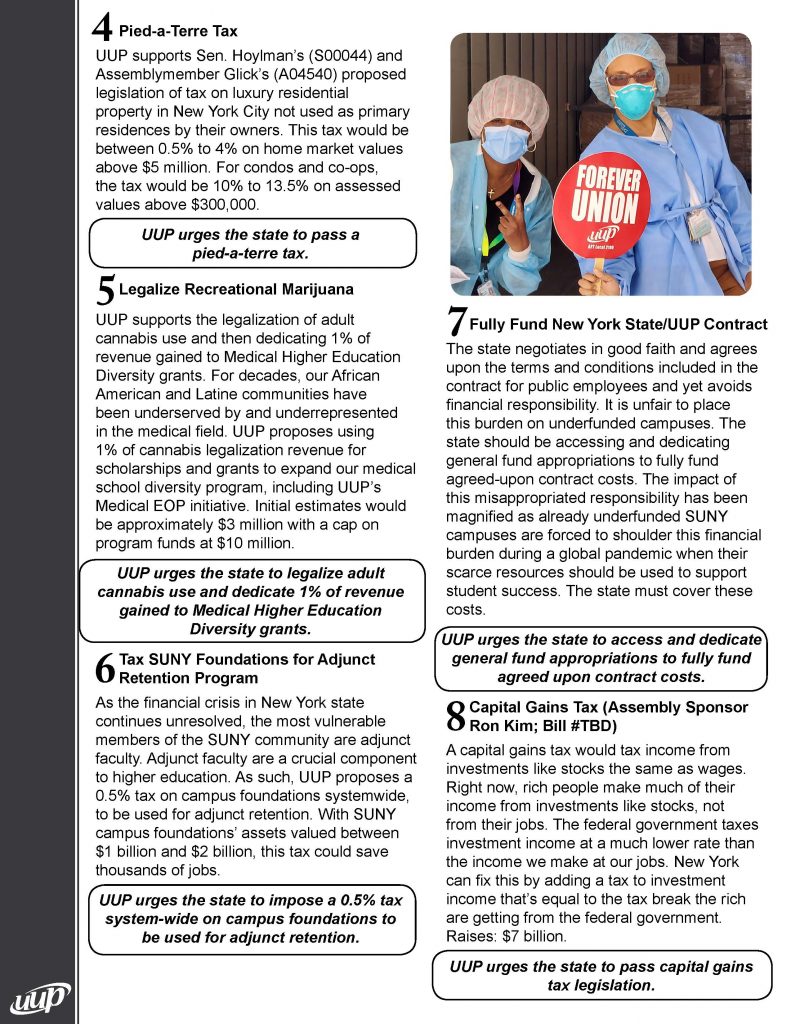
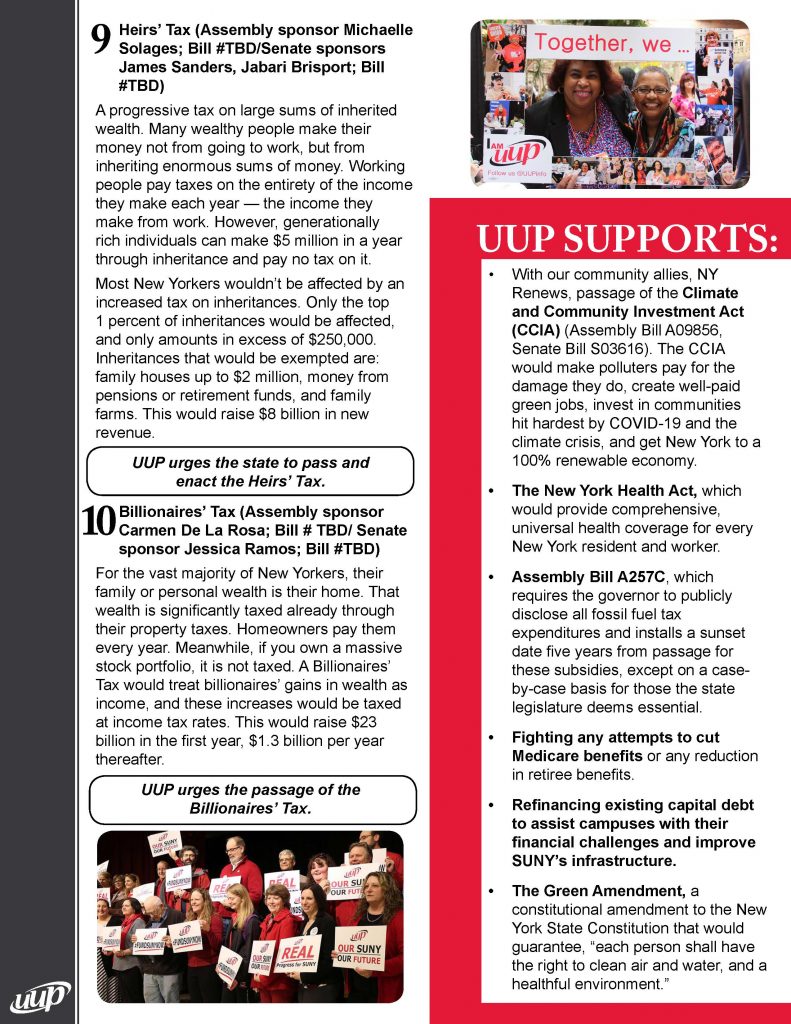
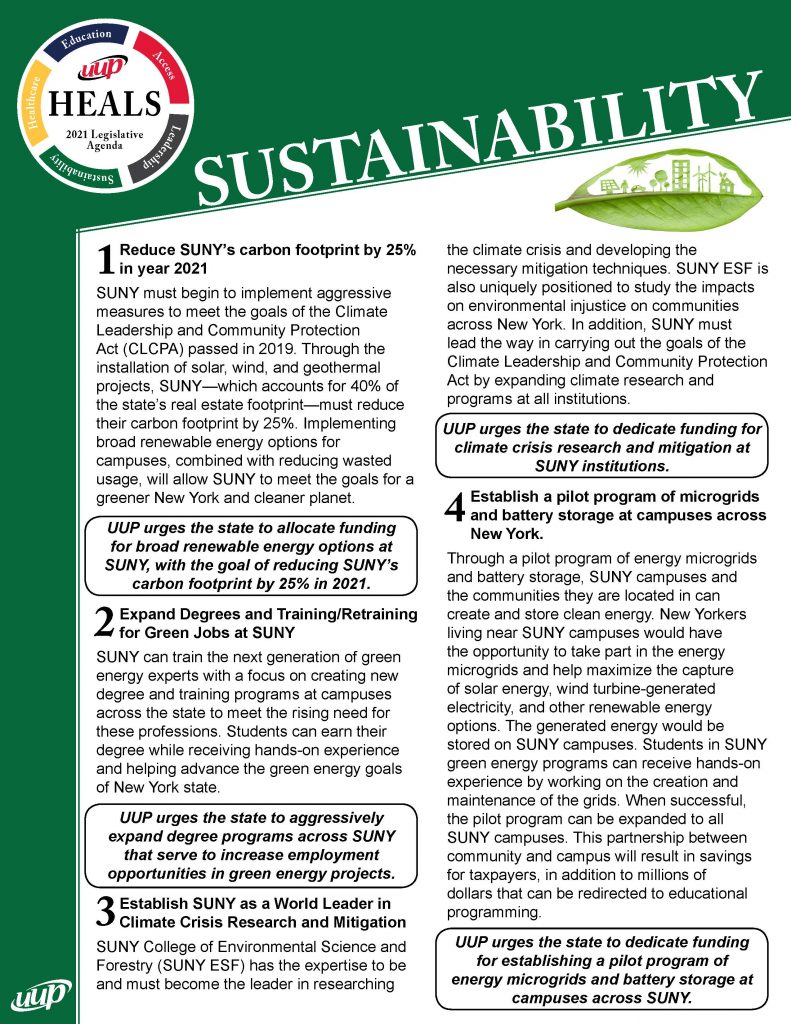

UUP 2021 State Legislative Agenda

Date posted: January 26, 2021

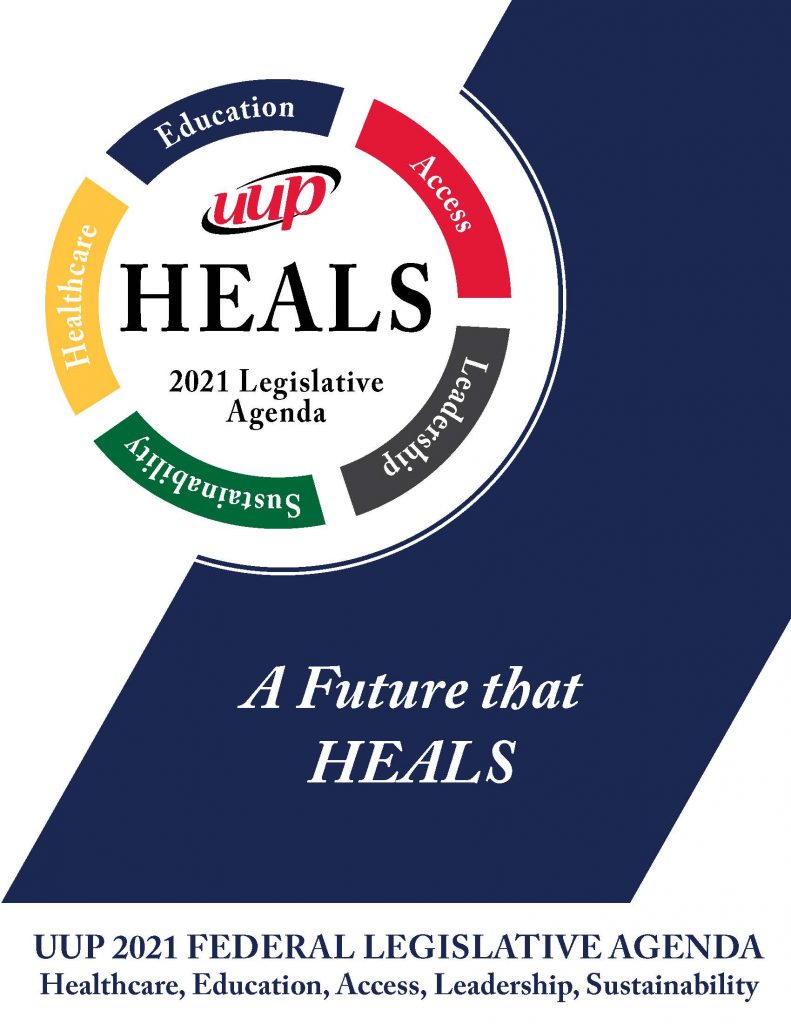
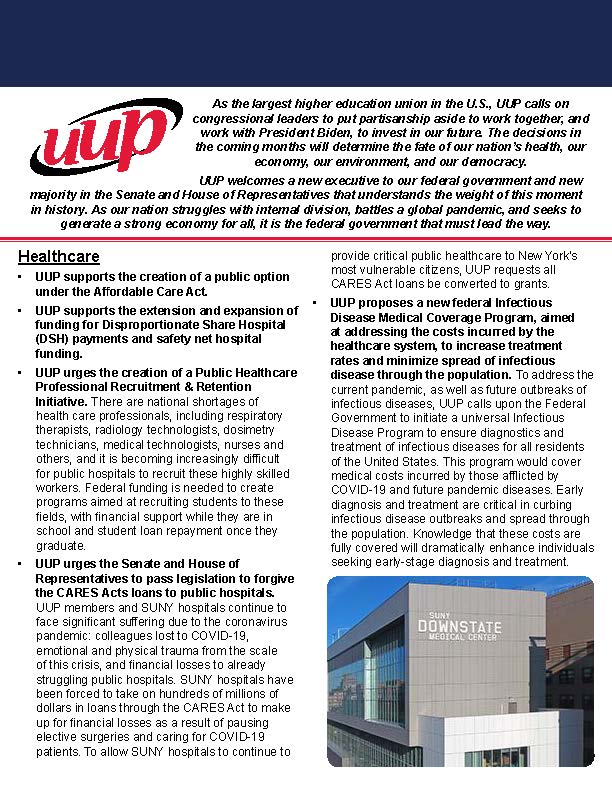
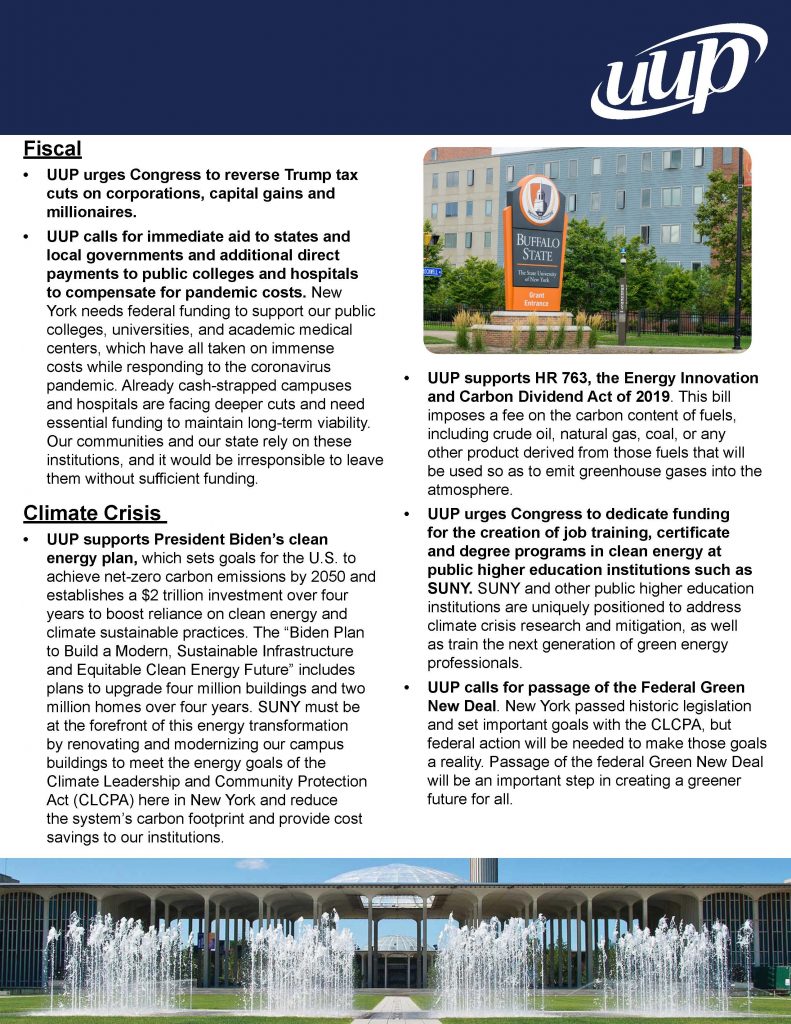
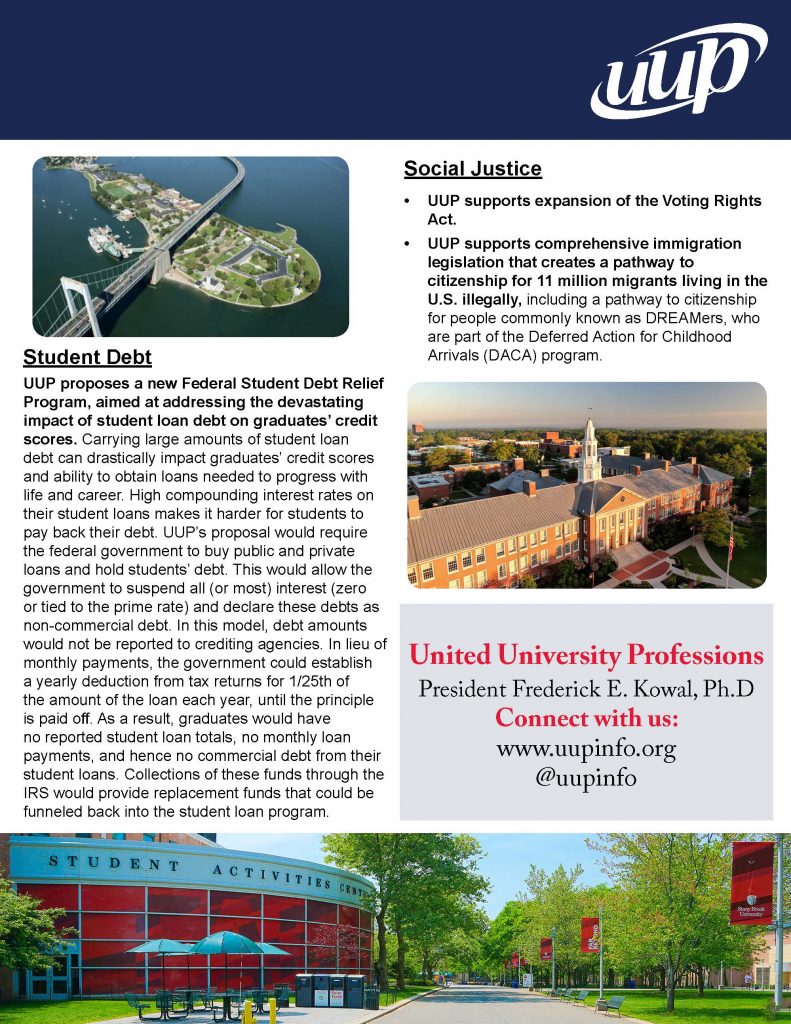
UUP 2021 Federal Legislative Agenda

Date posted:

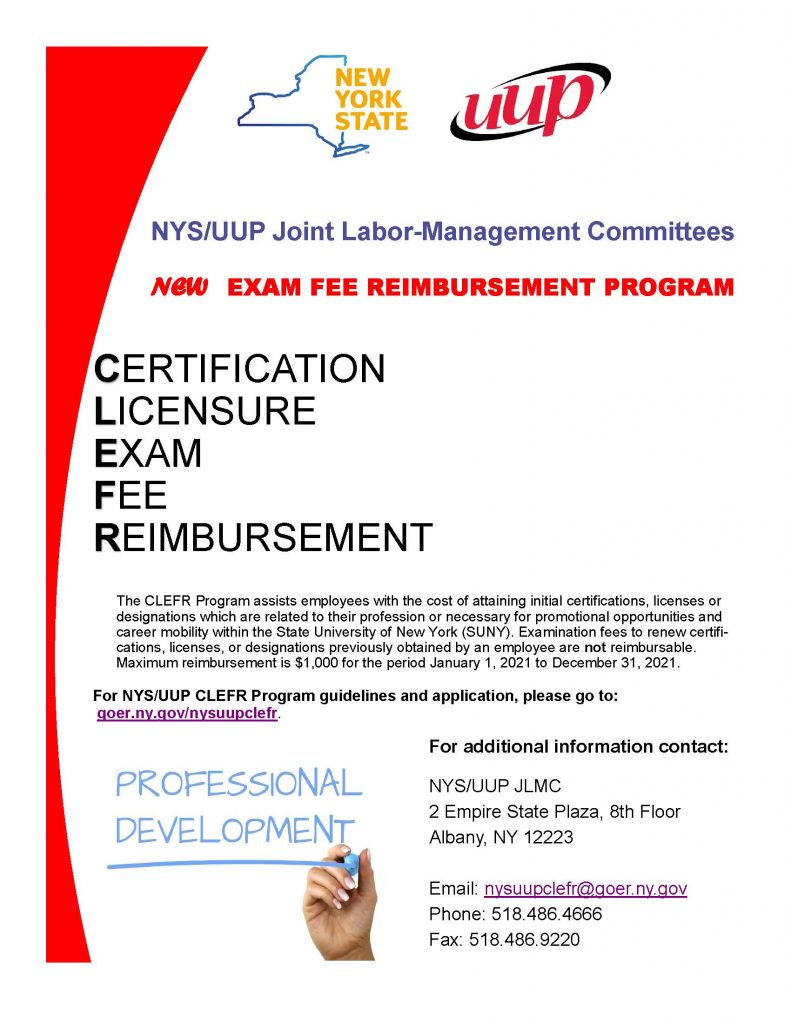
NYS/UUP JLMC ANNOUNCES NEW PROGRAM – Certification, Licensure Exam Fee Reimbursement Program (CLEFR)

Date posted:

CLEFR PROGRAM GUIDELINES

CLEFR PROGRAM APPLICATION

Part-Time Labor-Management Agenda Tuesday, January 19, 2021

Date posted: January 12, 2021

Old Business:

  1. With regard to the number of Part-Time Lecturers who taught at least one course in fall 2020, UUP requests an update on the following from the Dean of each of the three Schools for Spring 2021:
  1. Number of Part-Time Lecturers not invited back?
    1. Number of Part-Time Lecturers with reduced courses assigned?
    1. Number of Part-Time Lecturers with fewer than six contact/credit hours assigned?
  • UUP requests that Management consider utilizing our unemployed/underemployed adjunct pool, in addition to our unemployed Part-Time Assistant Coaches pool for folks to work at the COVID-19 testing center this spring.
    • Has management contacted any PT Assistant Coaches regarding employment at the testing center at this point? If so, how many?
    • Will these PT members also be sought out to work at the Vaccination Distribution center on campus, if Cortland agrees to act as one?
  • UUP would like to resume its discussion of the PT Handbook in Spring 2021, with a goal of finishing it before fall 2021, assuming other factors.

Labor-Management Agenda Thursday, January 21, 2021

Date posted: January 11, 2021

Items of Collegiality:

  1. UUP acknowledges Management’s cooperation with the MOA Regarding Possible Adjustments to Tenure Clock Timelines, and Re-appointment, Promotion, and Tenure Review Materials, allowing the exclusion of CTE results for the Fall 2020 semester, at the discretion of each individual faculty member, and we thank you for reinforcing this cooperation to all three Deans.
  2. UUP thanks Management for sharing the documents AFAC Pandemic Response and SUNY Cortland Fall Wind Down and Winter/Spring 2021 Operations Plan (December 10, 2020 version) for our input.
  3. UUP acknowledges Management’s facilitation of our first COVID-19 testing protocol consultative meeting on December 17.
  4. UUP acknowledges Management’s consideration of UUP’s Resolution on Mutual Aid.

New Business:

  1. Cabinet’s decline to support Resolution on Mutual Aid prepared/presented by UUP:
    1. Points of Clarification:
      1. UUP would like to convey that while we recognize that the resolution is vague in wording, we had no idea that the Cortland Foundation would generate the payroll directly, for such a donation program, only that they would collect the donations, and then they would transfer the funds to some account or other that could be earmarked for employing otherwise unemployed Part Time members.
  1. UUP would like to clarify that we are not suggesting that overstaffing the college is the solution to keep members employed; we submit that keeping more faculty employed allows the college to hold smaller classes, which is positively associated with both quality of education and marketability of the college.
  • For Further Discussion:
    • UUP thanks Management for their intention to hire Part Time folks who are unemployed or underemployed as workers for the Testing Center, and Quarantine and Isolation Programs: Is there a way that the folks who apply and are hired for this program can be made benefits eligible?
  1. In lieu of a program such as presented in the resolution, UUP seeks management’s collaboration in promoting the VRWS as a means to support the retention of Part Time faculty, by identifying some way to earmark some portion of those funds for this express purpose.
  • COVID -19 Vaccination Process at Cortland:
    • Who on Cortland’s campus will be responsible for our COVID-19 vaccination process, if anyone?
    • Has Cortland been chosen for a vaccination distribution site?
      • If so, is there a plan in place for the operation of this center? Does it involve UUP members?
    • UUP strongly encourages our Student Health Services folks and Student Facing folks be vaccinated first; when can we expect this may occur?
  • UUP understands that two “pacing” or “reading” days have been added to the spring 2021 academic calendar.
    • By what process were these days added?
    • Aside from the Faculty Senate representatives, what members of the faculty were consulted?
    • UUP understands that the days are Tuesday, March 9, and Wednesday, April 14; when will this be communicated to faculty, who are planning their Spring 2021 syllabi?

Old Business:

  1. Online Course Teacher Evaluations:
  1. As a part of this process, faculty do not seem to have been fully informed or notified about when CTEs were released with links to the students, or the timeline for completion; faculty have informed UUP that no CTEs were completed, and were unable to mention their availability during class time. How does administration plan to address these issues for the spring 2021 semester?
  • UUP has some concerns/recommendations about the AFAC Pandemic Response (White Paper):
    •  The paper stipulates, “Generally, the AFAC urges all levels of personnel review to be cognizant that the pandemic has affected faculty members in different ways, some are more able to cope with the changes and uncertainty than others, and faculty with school-age children have been given an added burden in terms of their education. As a result, we ask all levels of review to exercise compassion and flexibility regarding requirements for personnel decisions for all candidates.  Deficits in the candidate’s record clearly due to the pandemic should not be used to deny support for reappointment or continuing appointment.”
  1. UUP would like to know more about how “clearly due to the pandemic” will be defined, qualified, and determined.
  1. Will individual Personnel Committees be making such determinations? If so, how will equity in such decisions be maintained?
  • Planning for Spring 2021:
    • Has SUNY approved the plan?
  • Can you discuss any features of the plan at this point?
  1. Testing Protocol?
    1. Reporting?
    1. Enforcement?
    1. Screening?
    1. Residence Hall Density?
    1. Staffing, especially for Q & I duties?
    1. Server Capacity?
    1. Designated learning and social spaces (besides dorm rooms)?
  • Has administration thought about a point or threshold at which they might delay beginning or resuming in-person instruction, or move to a study-in-place position?
  • 2020 DSI discretionary awards, or plan to distribute award letters:
    • With the announcement of the Feb/March 2021, time line for distribution, may we have a more specific date of when distribution at Cortland will occur?
  • Is the salary compression analysis for Cortland complete?
  • Has Management reached out to professional members about short-term duties related to COVID-19 and not being evaluated upon those? If not, when do they plan to do so?
  1. The priority of COVID-19 and duties related to it will reach the one-year mark before the end of the spring 2021 semester. Will you further advise all professionals to reach out to their supervisors regarding these duties becoming long-term?
  • UUP has some concerns about the planned suspension of graduate programs and its impact on the positions of UUP members:
    • Has management consulted Deans, Department Chairs, and/or Faculty in making any decisions about suspending programs?
  1. UUP understands there was no consultation with Faculty or Chair in deciding to eliminate the MSED in Adapted Physical Education Program.
  • Is there a formal process in which the college engages before programs are suspended?
  • What other programs have been suspended 2019-2021? How and when have departmental faculty been informed about these determinations?
  • Does management further intend to begin the process to have those programs deactivated?

Labor-Management Agenda Thursday, December 17, 2020

Date posted: December 9, 2020

Items of Collegiality:

  1. UUP acknowledges the continued communication and collaboration between us and management as we continue to navigate the COVID 19 pandemic in the SUNY Cortland and surrounding community.

Old Business:

  1. Planning for Spring 2021:
  1. How soon will a draft plan be completed?
  • Can you discuss any features of the plan at this point?
  1. Testing Protocol?
    1. Reporting?
    1. Enforcement?
    1. Screening?
    1. Residence Hall Density?
    1. Staffing, especially for Q & I duties?
    1. Server Capacity?
    1. Designated learning and social spaces (besides dorm rooms)?
  • Will UUP members be given an opportunity to provide feedback on the plan?
  • April 30, 2020, Memorandum of Understanding on Tenure Clock Stops and Personnel Actions:
  1. Aside from the email from Human Resources late in the summer, how will the

campus put into practice this MOU, in terms of communication and implementation?

  • Can Management provide an update on the tracking system being developed?
  • How will evaluators be advised to proceed if campus or departmental policies contradict the MOU?
  • Faculty are required to perform CTEs on a timetable (e.g. once every third time they teach a course (Handbook 260.02, I.13), or more often based on departmental policies). If the person would have been required to perform CTEs in the spring of 2020 under ordinary circumstances, what will the expectations be for them?
  • The present crisis may have serious effects on scholarly activity, including publishers shutting down, delay of crucial fieldwork, and the like. If this has a long-term impact on a person’s research, will the campus still require three scholarly achievements in that case?
  • UUP requests a copy of the draft document generated by Andrew Fitzgibbon, mentioned at LM 10/15/2020, which Faculty Senate may adopt, which would outline hardships presented by COVID 19 to employee’s professional obligations.
  • Will there be a similar document drafted for professionals? UUP requests to review that document.
  • Has the campus been given authorization by the Division of Budget to pay DSI discretionary awards, or to distribute award letters?
  1. If not, do we have a timeline when these items might occur?
  • What is the status of the inequity analysis for 2020?
  • Will implementation of awards be retroactive to December 31,2020?
  • UUP Survey of Professionals, Summary Results:
  1. Results indicate communication issues with professionals:
    1. What is your plan for increasing accuracy of communications with employees before spring 2021?
  • Results indicate concerns about increased workload without compensation of any kind:
  1. What plan does Management have to document this temporary work, so as to prevent an increase in performance obligations without compensation?

New Business:

  • UUP has some concerns about the reconfiguration of the President’s Council:
  1. How will the President’s Council “create a concentrated deliberative body that brings multiple perspectives from across all campus constituencies,” that “requires more diverse voices at the highest levels of decision-making,” without direct representation of the faculty, labor unions, and other underrepresented groups on campus?
  • Can management characterize the “opportunity for faculty and staff to offer agenda items for Council meetings,” as stated in the message sent to employees?
  • Can you characterize what management means when it says the President’s Council will “have the ability to influence and enact policies that reflect those constituencies as well as our institutional mission,” in the message sent to employees?
  • How will the President’s Council plan to collaborate with UUP on issues that are related to the terms and conditions of employment of its members?
  • UUP has some concerns about the planned suspension of graduate programs and its impact on the positions of UUP members:
  1. Has management consulted Deans, Department Chairs, and/or Faculty in making any decisions about suspending programs?
    1. UUP understands there was no consultation with Faculty or Chair in deciding to eliminate the MSED in Adapted Physical Education Program.
  • Is there a formal process in which the college engages before programs are suspended?
  • What other programs have been suspended 2019-2021?
  • Does management further intend to begin the process to have those programs deactivated?

Labor-Management Agenda Thursday, November 19, 2020

Date posted:

Items of Collegiality:

  1. UUP would like to inform Management of their Holiday Food Drive, a collaboration with Catholic Charities of Cortland County, going on now until December 4, during which we will be collecting non-perishable food items, hygiene items, and gifts to benefit needy families in Cortland County.
  2. UUP acknowledges the continued communication and collaboration between us and management as we continue to navigate the COVID 19 pandemic in the SUNY Cortland and surrounding community.

New Business:

  1. Precisely how many faculty have agreed to take an overload in fall 2020?
  • Taking into consideration the proposed hard hiring freeze, what is management’s plan for addressing the continual overloads taken on by tenure track faculty and junior faculty in the School of Professional Studies, particularly as it pertains to the Department of Physical Education?
  • With regard to the number of Part-Time Lecturers who taught at least one course in fall 2020, UUP requests an update on the following from the Dean of each of the three Schools for Spring 2021:
  1. Number of Part-Time Lecturers not invited back?
    1. Number of Part-Time Lecturers with reduced courses assigned?
    2. Number of Part-Time Lecturers with fewer than six contact/credit hours assigned?
  • Does management intend to complete the 2020 DSI process and distribute awards by December 31?
    • Has any consideration been given to across-the-board awards for all employees?
  • Has any consideration been given to an across-the-board award for part-time employees?
  • What is the status of the inequity analysis for 2020?
  • UUP Survey of Professionals, Summary Results:
  1. Results indicate communication issues with professionals:
    1. What is your plan for increasing accuracy of communications with employees before spring 2021?
  2. General responses indicate, for example, an understanding that residence halls have been operating at 100% capacity.
  • Results indicate concerns about increased workload without compensation of any kind:
  1. What plan does Management have to document this temporary work, so as to prevent an increase in performance obligations without compensation?
    1. 27% of respondents said there was a change to work schedule with no accompanying change to performance program.
    2. 33% change in workload with no accompanying change in performance program.
  • Results indicate some areas were provided with equipment to telecommute:
  1. How many and which areas specifically were provided with equipment to enable employees to telecommute?
    1. UUP has concerns about equity in providing equipment to enable employees to telecommute.
  • Campus Student Surveys: UUP has some concerns about reported issues with bias in the survey, reported in a Town Hall meeting held by the Concerned Faculty Committee and which were read out at Faculty Senate.
  1. Will the results of the survey be used to evaluate faculty, either generally or specifically?
  • Planning for Spring 2021:
  1. In what ways is planning for the spring semester being done?
  • In what ways might the faculty and other employee groups on campus be consulted in the planning process?
  • How soon will a draft plan be completed?
    • Can you discuss any features of the plan at this point?
  • Will UUP members be given an opportunity to provide feedback on the plan?

Old Business:

      1. April 30 Memorandum of Understanding on Tenure Clock Stops and Personnel Actions:

  1. Aside from the email from Human Resources late in the summer, how will the

campus put into practice this MOU, in terms of communication and implementation?

  • Can Management provide an update on the tracking system being developed?
  • How will evaluators be advised to proceed if campus or departmental policies contradict the MOU?
  • Faculty are required to perform CTEs on a timetable (e.g. once every third time they teach a course (Handbook 260.02, I.13), or more often based on departmental policies). If the person would have been required to perform CTEs in the spring of 2020 under ordinary circumstances, what will the expectations be for them?
  • The present crisis may have serious effects on scholarly activity, including publishers shutting down, delay of crucial fieldwork, and the like. If this has a long-term impact on a person’s research, will the campus still require three scholarly achievements in that case?
  • UUP requests a copy of the draft document generated by Andrew Fitzgibbon, mentioned at LM 10/15/2020, which Faculty Senate may adopt, which would outline hardships presented by COVID 19 to employee’s professional obligations.
  • Will there be a similar document drafted for professionals? UUP requests to review that document.

Labor-Management Agenda Thursday, October 15, 2020

Date posted:

Items of Collegiality:

  1. UUP acknowledges the instrumental role management and all folks at Cortland have played in maintaining a campus with fewer than 100 positive cases of Corona Virus during the period ending September 25.
  • UUP acknowledges inclusion of a UUP representative on the COVID 19 Coordinating Committee.

New Business:

  1. UUP requests a report on the financial stability of the college:
    1. Where can UUP find SUNY Cortland’s 2020-2021 budget information to review?
  • What budget shortfall, if any, is Cortland experiencing in fall 2020? Spring 2021?
  • Precisely what amount of allocation has been allotted to SUNY Cortland? What amount has been received to date?
  • Does the college anticipate any additional or supplemental allocation from the state at this point?
  • Can management characterize any stresses placed upon particular budget lines, such as temporary services, also receives, or extra service?
  • Are rank-to-rank promotions that are accompanied by an increase in base salary being honored at this time?
  • Can you provide an update on student enrollment – e.g. how many students have withdrawn, what indications we’ve had about enrollment for the spring?
  • Draft Policy: Course Planning Cancellation Guidelines:
    • At what point has/will the draft become official college policy?
  • Can you provide some additional clarification regarding the purpose of the policy, should it be implemented, as it relates to the rationale briefly explored in the August 2020 LM meeting?
  • How will the policy be implemented? Will every lower division course be cancelled if enrollment does not reach 20 students? Upper division undergraduate courses whose enrollment fails to reach 20? Graduate courses whose enrollment fails to reach 10?
  • If exceptions can be made, as the draft stipulates, how and under what circumstances will an exception be made, especially an “additional exception” that is not directly related to students’ needs to graduate?
  • Will exceptions be made if student need dictates, regardless of faculty member assigned to the course?
  • Under what circumstances will courses that have multiple sections be consolidated? Will this apply uniformly to all courses taught? If so, what considerations will be made for faculty workload and compensation?
  • Can you provide some clarification regarding what management means by “shared resources when appropriate” in the draft of the policy?
  • Curtailment of the in-person Tuesday-Thursday classes:
    • Can management discuss the considerations you have given to President Pittsley’s recommendations in her follow-up to 9/17 LM email (briefly outlined below):
      • UUP asks management to empower their faculty, who would never make a cavalier decision about moving a course to 100% remote learning, to make those decisions.
  1. UUP encourages management be flexible in empowering faculty to take a reasonable amount of time (perhaps including cancelling classes for a day or two) to modify their courses due to this new time restraint, and inform their Deans and Chairs of their need to do so;
  1. UUP encourages management to hold widely publicized trainings for personnel committee members (present and future) and Chairs to be flexible in accepting and holding harmless faculty who must make alterations to their workload in order to meet the demands of the semester, and this academic year; 
  1. UUP asks for flexibility in documenting these changes in their annual reports.
  • April 30 Memorandum of Understanding on Tenure Clock Stops and Personnel Actions:
  1. How will the campus put into practice this MOU, in terms of communication and implementation?
  • How will evaluators be advised to proceed if campus or departmental policies contradict the MOU?
  1. Faculty are required to perform CTEs on a timetable (e.g. once every third time they teach a course (Handbook 260.02, I.13), or more often based on departmental policies). If the person would have been required to perform CTEs in the spring of 2020 under ordinary circumstances, what will the expectations be for them?
  1. The present crisis may have serious effects on scholarly activity, including publishers shutting down, delay of crucial fieldwork, and the like. If this has a long-term impact on a person’s research, will the campus still require three scholarly achievements in that case?
  • How many members of UUP are currently working in interim positions, and for how long have those members been working in those positions?
    • Do those folks who are serving in interim positions have written performance programs, expectations, or duties?

UNION STRONG…UNION COMPASSIONATE

Date posted: December 7, 2020

by Jo Schaffer, Art and Art History Emerita –

Union Strong is our call to members to remind them that we all win when we hang together. It also reminds them, more subtly, that we are only as strong as our weakest link, and as such, we need to support the weakest among us. So it was warming and heartening to see that not only were we UNION STRONG but UNION COMPASSIONATE during this past year’s call for donations to the Holiday season Food Bank. This year UUP worked closely with Catholic Charities of Cortland to be the distributor of the boxes of food and personal items donated. 

Not only were there boxes at sites across the campus but two off-site locations, at Henry Steck and Jo Schaffer’s homes, for drop off for retirees and others who did not feel comfortable coming to campus because of the pandemic.

According to past drives, this year’s contributions were the largest ever received. Many of you were extraordinarily generous and thoughtful in your anonymous contributions. Some donated mittens and gloves, hair products, plush toys, games and much more than cans of beans and tuna, boxes of cereal and spaghetti. These contributions will make some families enjoy moments of joy beyond the necessity of food.

UUP thanks to all of you who made this year’s FOOD BANK drive so successful.

To all, have a warm, healthy and happy holiday season.

Winter is Coming: COVID-19 at Cortland

Date posted:

by Dan Harms, Vice President for Academics – Last week, I had no idea what I was going to write about in the newsletter. So much uncertainty and change has swirled around us in the nation, state, campus, and home – what would be relevant by the time you read this?

One fact is evergreen: UUP employees work hard and pull through. We have had the messiest, most chaotic semester in living memory, and academics and professionals, tenure-track and contingent faculty, all pulled together to teach and assist our students under grueling conditions hitherto-unimagined. Further, not one employee at Cortland has, according to our dashboard, been hospitalized or lost their life to this disease. So, first, let me offer my congratulations on our survival and success.

Most of us haven’t had an opportunity to ask how our fellow campuses are doing. Let’s take a look.

The New York Times created a nationwide map of college campuses to show the number of COVID cases reported on each (https://www.nytimes.com/interactive/2020/us/covid-college-cases-tracker.html). It seems most of the data is self-reported as of November 19, so we should take the numbers with caution. Also, there’s considerable variation in certain metrics, such as whether the campus counts number of positive tests or number of positive individuals, and county health departments might make different requests of the campuses within them.

 If you zoom in and out of the map, the names of different campuses appear and disappear. When zoomed out entirely, however, only one campus’ name appears over our state: SUNY Cortland. To be fair, this seems to be a product of how the map is generated; on the list further down the page, SUNY Oneonta edges out Cortland for the most reported cases in-state. Yet according to the SUNY COVID dashboard (https://www.suny.edu/covid19-tracker/ ), we have had more cases than Oneonta, ranking first in the system. This is in a state with colleges of staggering size, some of which have been in veritable COVID-19 hotspots.

Have our colossal efforts to repeatedly test the campus ratcheted up our numbers? Positivity of tests administered may be a better indicator of spread within a population. We do not have figures for colleges across the state, but as of today, Cortland (2.7%) ranks at third on the SUNY dashboard, behind Upstate Medical (3.9%) and Oneonta (3.5%).

I am not any sort of specialist on health or statistics. Some sources of data are contradictory, and many colleges may not be as forthright as ours about their numbers. We will certainly see an accounting later detailing how accurate or representative these measures have been, or if any measures we took as a campus might have made a difference.

No matter what we might find later, however, students will be returning to Cortland in less than two months. A cold Central New York winter will constrain more students to indoor settings, leading to greater possibility of transmission.

Cortland has been asked to submit a plan to SUNY for review for the February re-opening. I hope that whatever plan we present takes lessons from our campus, and successful efforts pursued at others, in order to preserve the safety of employees and students alike.